Step 1
Our treatments against pathogens
Disinfection aims to destroy viruses, bacteria, moulds and pathogens both on contact surfaces and in the ambient air. Our protocols rely on authorised virucidal products compliant with standard EN 14476 (enveloped and naked viruses) and bactericidal standard EN 1276, chosen according to the context: post-disaster restoration, epidemic context, medical or food environment. Each intervention is tracked and results in a certificate specifying the products, treated surfaces and re-entry period.
Diagnosis and disinfection plan
Before any intervention, identification of priority contact surfaces, at-risk areas (sanitation, ventilation, textiles) and the context (post-disaster, epidemic, food-related). This diagnosis dictates the product/method pairing and the re-entry period.
Virucidal & bactericidal spraying
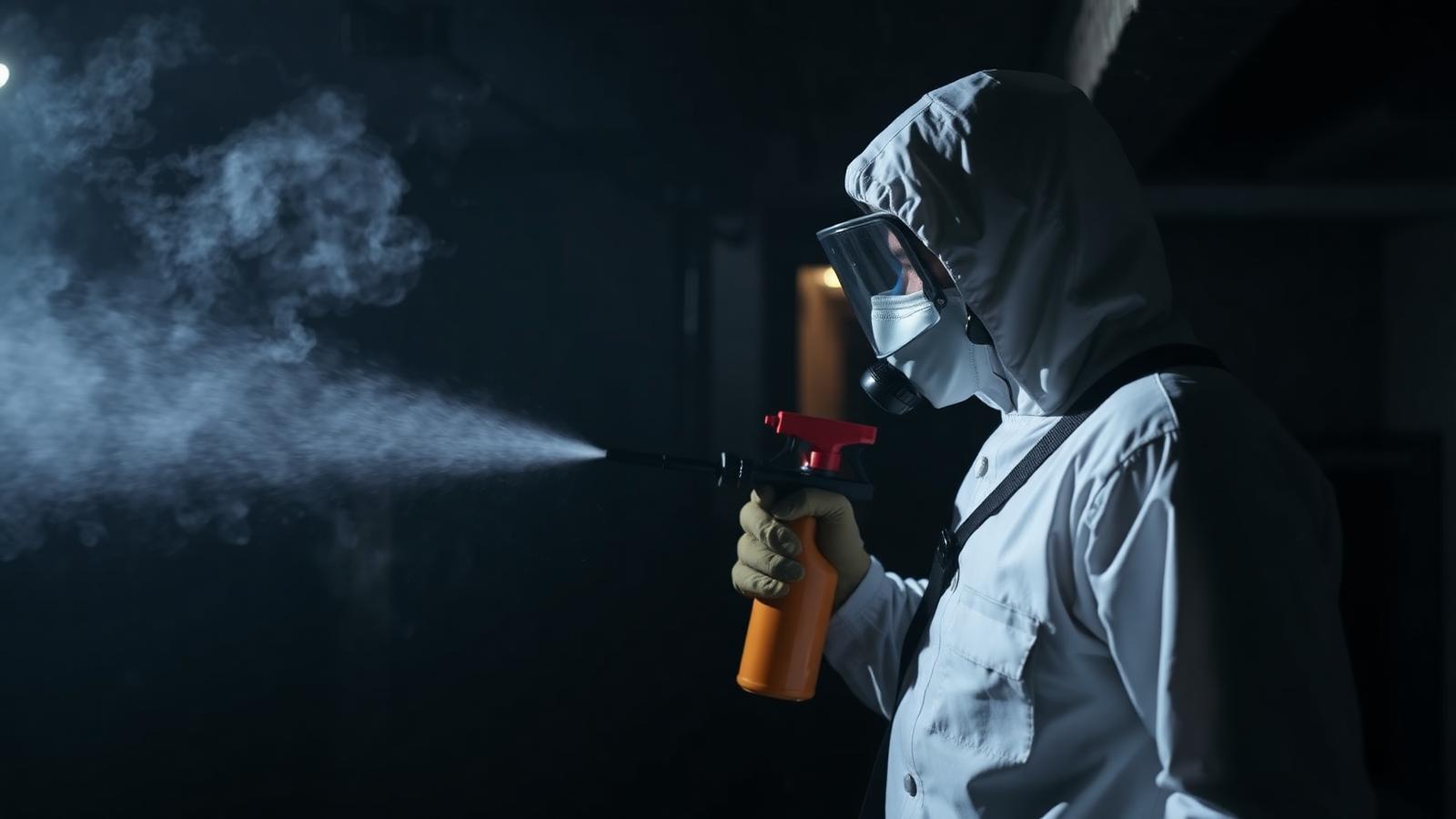
Application of authorised TP2/TP4 disinfectant on all contact surfaces (handles, worktops, toilets, keyboards, remote controls). Standard EN 14476 (viruses) and EN 1276 (bacteria). Re-entry period: 1 to 2h depending on the product used.
Cold fogging (ULV)
Diffusion of an ultra-fine dry mist (droplets < 50 µm) that penetrates every nook, textile, carpet and ventilation system. Ideal for large areas, offices, gyms, public transport and co-ownerships.
DSVA — Airborne Surface Disinfection
For sensitive environments (medical practices, care homes, laboratories): automated diffusion of hydrogen peroxide (H₂O₂) in a hermetically sealed room. Terminal disinfection validated by placement of biological indicators before return to service.
Post-disaster protocol
After water damage, death, infestation or professional food context: thorough cleaning of surfaces, complete disinfection, dehumidification if necessary, odour neutralisation and detailed intervention certificate issued at the end of the project.
Step 2
Habitat and behaviour of pathogens
Viruses, bacteria, moulds and pathogens survive where they find moisture, organic matter and repeated contact points: handles, switches, toilets, keyboards, worktops, ventilation systems, carpets and upholstery. High-traffic premises — nurseries, medical practices, care homes (EHPAD), schools, gyms, restaurants, open-plan offices, public transport — concentrate these cross-contamination flows and require constant health vigilance. Certain agents (noroviruses, sporing bacteria, moisture-related moulds) can remain active for several days on a surface if not correctly disinfected.
Step 3
What causes an infestation?
The need for professional disinfection arises in five main contexts: after a disaster (water damage promoting mould growth, death at home, fire, emergency services intervention), following a pest infestation (rodents, cockroaches, pigeons) which leaves behind droppings and secondary parasites, in an epidemic context (gastro, flu, Covid, scabies) in collective settings, during compliance restoration requested by hygiene services (DDPP, ARS) after an unfavorable opinion, and before or after works in premises intended to receive the public. High traffic, lack of ventilation, absence of cleaning protocols and occupant turnover systematically amplify these situations.
Step 4
How do you recognise an infestation?
The need for disinfection rarely appears through a single sign: it becomes necessary after a disaster (water damage, death, fire start), following a pest infestation, in an epidemic context, or when faced with persistent odours and mould spots on walls and ceilings. For professionals, it is also a mandatory step before opening, after works, or during a standard compliance restoration requested by hygiene services. A quick diagnosis identifies the surfaces, ambient air and textiles to be treated.
Step 5
Where do they hide?
Germs concentrate where hands, droplets and organic matter circulate: handles, switches, keyboards, toilets, collective kitchens, ventilation systems, carpets and upholstery. Our protocols map these priority contact points before deciding on the product/method pairing, as treating only the floor or visible surfaces leaves zones for immediate re-contamination.
Step 6
Health and property risks
Incomplete disinfection leaves active germs where they circulate most, exposing occupants to cross-infections, allergies and asthma attacks. In medical, food or collective environments, regulatory risk is added to the health risk: a non-compliance notice during a hygiene inspection can suspend activity until compliance is restored, not to mention the image impact on users or customers.
Step 7
Our 5-step intervention
- 1
Full inspection
Complete inspection of the premises, precise identification of the pest, assessment of the infestation level and of the layout of the site in order to define the most effective intervention strategy.
- 2
Transparent quote
A detailed quote is issued before any intervention, presenting the recommended solutions, the response times and any travel costs that may apply.
- 3
Professional treatment
Intervention carried out by a certified technician using mechanical, thermal or chemical methods suited to your situation, in full compliance with current regulations.
- 4
Prevention & proofing
Identification of the causes of the infestation, tailored recommendations and, where necessary, sealing of entry points to limit the risk of re-infestation.
- 5
Follow-up & support
An intervention report is issued, along with post-treatment advice and the option to schedule a follow-up visit or a monitoring contract according to your needs.
Step 8
Disinfection price list — Paris & Île-de-France
Indicative prices — exact quote issued after the free diagnosis.
| Surface | Indicative price |
|---|---|
| up to 30m² | from 249 € |
| up to 60m² | from 299 € |
| up to 90m² | from 349 € |
| 120m² and above | on quote |
Step 9
How can infestations be prevented?
To durably preserve the sanitary quality of premises, daily ventilation, regular cleaning and disinfection of contact surfaces, scheduled maintenance of ventilation systems and staff training in barrier gestures remain the most effective levers. Sensitive sites — medical practices, care homes (EHPAD), professional kitchens, nurseries — benefit from a preventive disinfection contract with scheduled visits and an intervention certificate kept in the sanitary register.
Step 10
Disinfection — FAQ
How long does an intervention take?
Between 1 and 4 hours depending on the surface area and the level of infestation.
Are the treatments dangerous for children and pets?
Our protocols strictly comply with regulations. A re-entry period will be specified for you.
Do you handle emergencies?
Yes, intervention within 24h across the whole of Île-de-France. Intervention 7 days a week, 24/7.
Is there a guarantee?
Yes, a results guarantee with follow-up visits included depending on the service.
What area do you cover?
Paris (75), 77, 78, 91, 92, 93, 94, 95 — the whole of Greater Paris.
Prevention and follow-up — optional add-on service
Beyond the disinfection treatment itself, SOS 4D Paris offers an optional scheduled follow-up visit to verify how well the protocol worked, detect any renewed activity and adjust the devices if needed. This separately invoiced service includes an inspection of the treated areas and sensitive spots, a check of the baits or traps in place, a comparative assessment and a written report handed over directly.
To prevent the pest from coming back, we identify the contributing factors specific to your home or premises — entry points, food sources, damp areas, sealing defects — and give you concrete recommendations to implement yourself. A periodic visit contract (quarterly, half-yearly or yearly) is also available on quote for long-term protection; its price depends on the chosen frequency and the site configuration.
Need a fast intervention?
Our certified technicians intervene within 24h across Paris and Île-de-France.