Chemical or thermal treatment: which method to choose?
When faced with an infestation, there is no universal solution. The choice of treatment depends on the type of pest, the extent of the infestation, the layout of the premises as well as your constraints (presence of children, animals, professional activity, establishment open to the public, etc.).
At SOS 4D Paris, every intervention begins with a diagnosis to precisely identify the source of the infestation and select the most effective method. Our certified technicians always favour the solution offering the best compromise between effectiveness, safety and durability, while complying with regulations relating to biocidal products.
Depending on the situation, we can implement a chemical treatment, a thermal treatment, or combine several techniques to achieve an optimal result.
Chemical treatment: the reference solution against most pests
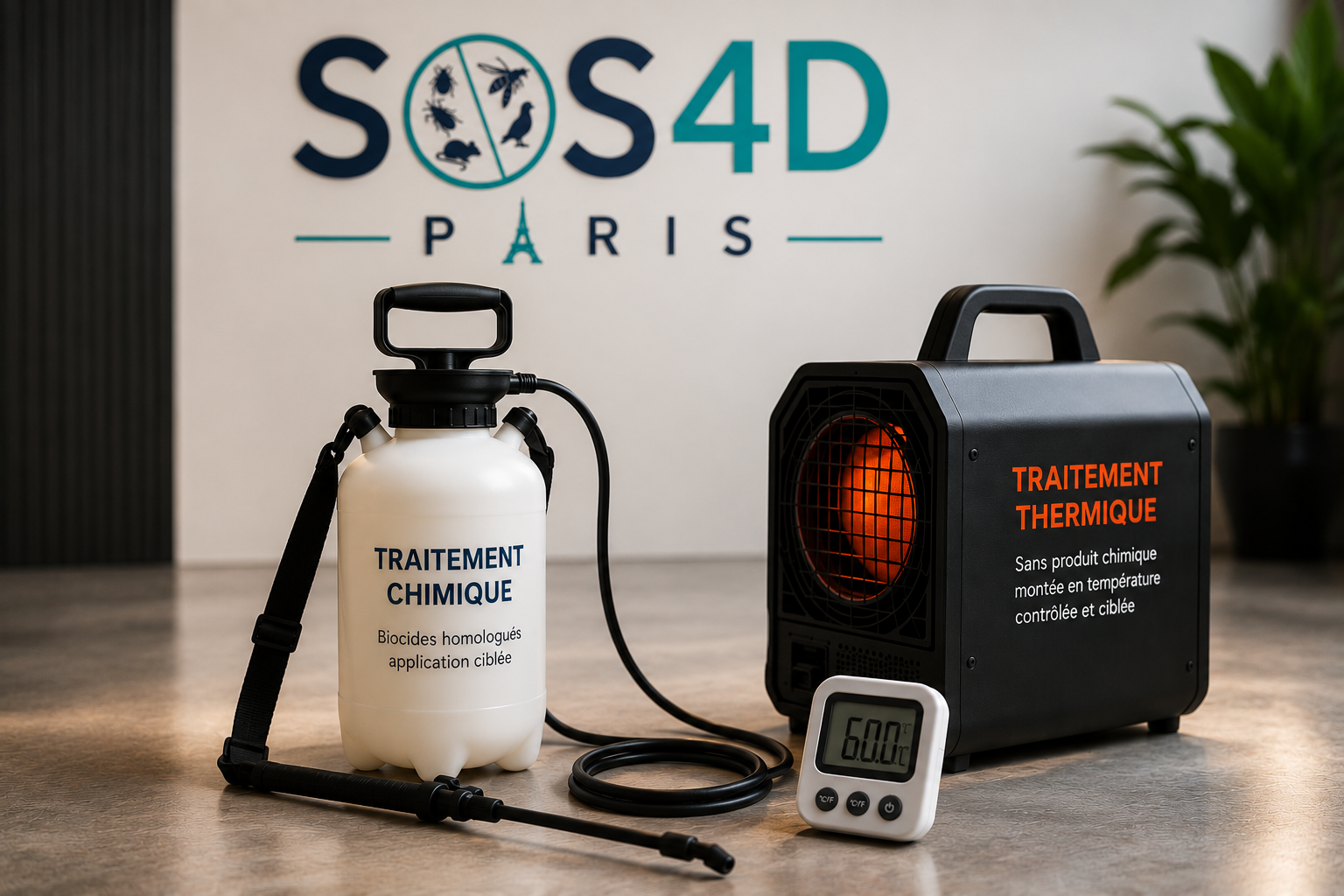
Chemical treatment involves applying authorised professional biocides in a targeted manner to infested areas or pest pathways. The products used are selected according to the species involved and applied only when their use is justified.
This method is now the most widely used to combat many infestations such as cockroaches, ants, wasps, hornets, fleas, moths, as well as in some cases of rodents or bed bugs.
Thanks to their knowledge of pest behaviour, our technicians target strategic areas to maximise the effectiveness of the treatment while limiting the amount of product used.
The advantages of chemical treatment
- Very effective against most pests.
- Fast action depending on the species treated.
- Suitable for homes, shops, restaurants, offices and industrial sites.
- Able to intervene even on major infestations.
- Use of products authorised in accordance with French regulations.
The advantages of thermal treatment
- No use of chemical products.
- Elimination of adult bed bugs, larvae and eggs.
- Premises can be re-occupied after cooling.
- Suitable for sensitive individuals when this method is technically feasible.
- Respects materials compatible with the temperature increase.
Thermal treatment: a method without the use of chemical products
Thermal treatment relies on a controlled rise in temperature to a level lethal to pests. Unlike chemical treatments, this technique requires no biocide and acts directly through heat.
This method is particularly well known for treating bed bugs, as it eliminates insects at every stage of their development, including eggs, which are often harder to destroy with other methods.
Thermal treatment is also particularly suited to sensitive environments where the use of chemical products is limited or undesired, such as certain hotels, rooms, establishments open to the public or occupied dwellings.
Comparison of the two methods
| Criterion | Chemical treatment | Thermal treatment |
|---|---|---|
| Principle | Targeted application of authorised biocides | Controlled increase in temperature |
| Chemical products | Yes | No |
| Effectiveness | Very high depending on the pest | Very high against bed bugs |
| Action on eggs | Varies depending on the protocol | Yes |
| Duration of intervention | Varies depending on the service | On average one day |
| Re-occupation | According to the technician's instructions | After the premises have cooled down |
| Recommended use | Cockroaches, ants, wasps, hornets, moths, fleas, rodents... | Mainly bed bugs |
Which method is best suited to your situation?
The best treatment depends above all on the pest involved. There is no single solution applicable to all infestations.
At SOS 4D Paris, our technicians carry out a diagnosis before every intervention to determine the most effective method. Depending on the case, we favour a chemical treatment, a thermal treatment or a combination of several techniques to achieve a lasting result while limiting the impact on your environment.
Our goal is not to systematically apply one method, but to choose the one that will give the best result for your situation.
Not sure which method to choose?
Our experts advise you free of charge after a personalised diagnosis across Île-de-France.
Get a personalised recommendation